

© 2024 NZBERS. All Rights Reserved.
Created by BePartOf.

NZBERS2026
"People and the Built Environment"
Symposium themes:
-
Health, Safety and Wellbeing
-
Skills, Education and Workforce Development
-
Leadership and Empowerment
-
People, Policy and Industry Support
-
Innovation, Research and Collaboration
-
Design, Culture and Community Impact
NZBERS 2026 provides a practical platform for construction and built environment professionals to share knowledge, showcase innovation, and connect research with real-world industry challenges. Industry participants will gain early access to emerging research, tools, and case studies, while exploring opportunities for applied research collaboration, student internships, and professional development with the School of Built Environment. We welcome theoretical, empirical, practice-based, and policy-focused contributions, and strongly encourage submissions from early-career researchers, postgraduate students, and industry practitioners. Endorsed by the International Council for Research and Innovation in Building (CIB) and the Australasian Universities Building Education Association (AUBEA), and held in Wellington, New Zealand, the symposium offers valuable opportunities to engage with government and key sector organisations, including BRANZ and the Ministry of Business, Innovation and Employment (MBIE).
12 - 13 November 2026
Massey University, Wellington, New Zealand
NZBERS 2026 provides a practical platform for construction and built environment professionals to share knowledge, showcase innovation, and connect research with real-world industry challenges. Industry participants will gain early access to emerging research, tools, and case studies, while exploring opportunities for applied research collaboration, student internships, and professional development with the School of Built Environment. We welcome theoretical, empirical, practice-based, and policy-focused contributions, and strongly encourage submissions from early-career researchers, postgraduate students, and industry practitioners. The symposium offers valuable opportunities to engage with government and key sector organisations, including BRANZ and the Ministry of Business, Innovation and Employment (MBIE).
Abstract Submission Closing
30 April 2026
Abstract Acceptance
15 May 2026
Full Paper and Extended Abstract Submission Closing
30 June 2026
Full Paper and Extended Abstract Acceptance
07 September 2026
Revised Paper Submission Closing
30 September 2026
Camera Ready Submission Closing
15 October 2026
NZBERS2026 Symposium
12 - 13 November 2026

Chairs
Dr. Don Samarasinghe
Massey University
Assoc. Prof. Michael Rehm
University of Auckalnd
AdvisorsDr. Wajiha Shahzad
Massey University
Prof. Monty Sutrisna
Massey University
Prof. James Rotimi
Massey University
Dr. Eziaku Rasheed
Massey University
Organising Committee
Dr. Mikael Boulic
Massey University
Dr. Chandana Siriwardana
Massey University
Dr. An Le
Massey University
Dr. Zhenan Feng
Massey University
Mr. Wajhat Ali
Otago Polytechnic Auckland Campus
Dr. Harold Aquino
Massey University
Dr. Chinthaka Atapattu
Massey University
Dr. Fahimeh McGregor-Zaeri
Delta Informed Decisions
Dr. Imelda Piri
Auckland University of Technology
Dr. Fei Ying
Massey University
Dr. Vishal Kumar
Massey University
Dr. Elrasheid Elkhidir
Massey University
Dr. Wallace Enegbuma
Victoria University of Wellington
Mr. Wajhat Ali
Otago Polytechnic Auckland Campus
Abstract and Extended Abstract Submission Link
Please login to Microsoft CMT using the link below for submission. First you need to register a Microsoft CMT account. Then click on “Create new submission” on the top left of the page to proceed with the submission.
Full Paper Submission Link
Please login to Microsoft CMT using the link below for submission. If you have submitted an abstract before, replace the abstract document with the full paper document.
Abstract Template
Extended Abstract Template
Full Paper Template
Presentation Template
Note*
All accepted papers for NZBERS2026, in accordance with our agreement with Springer Nature, will be published in the proceedings and Scopus Indexed.
All extended abstracts will be published in the Book of Abstracts (not Scopus-indexed).

Senior Healthy Water Specialist, Auckland Council
Civil Engineer and Governance Practitioner
People at the Centre: Why Capability Will Shape Aotearoa’s Infrastructure Future
Aotearoa is heading into a period of overlapping infrastructure reform, water sector change, climate pressures, and rising expectations from communities. We often talk about these shifts in terms of assets, funding, or structure. But the factor that is already shaping outcomes the most is capability, who we have, who we’re losing, and who we’re not developing fast enough.
This keynote looks at the emerging workforce gap across engineering, operations, asset management, planning, and regulatory roles. The loss of experienced practitioners and the thinning of the mid career cohort are creating real constraints on delivery and resilience.
Drawing on research into infrastructure resilience and organisational recovery, I argue that resilience is increasingly determined by people and systems, not just assets. Organisations with strong leadership and mature capability recover faster and deliver more consistent results.
To make this concrete, I outline three possible futures for Aotearoa: one where capability continues to erode, one where we rely heavily on overseas expertise, and one where we treat workforce development as national infrastructure.
The abstract closes with a call to stewardship, a shared responsibility across the sector to build the capability base needed for a resilient, future focused Aotearoa.

Chief Executive, Asian Family Services (AFS)
Ethnic Advisory Board Member NZ Police
The Tip of the iceberg- A Cultural Lens on Wellbeing and Suicide Prevention in Construction
Construction is one of Aotearoa’s largest workforces and one of its highest-risk industries for suicide. MATES in Construction reports that male construction workers face nearly twice the suicide rate of other men, 19.7 compared with 10.6 per 100,000, with more than one construction worker dying by suicide every week. The New Zealand Chinese Building Industry Association’s 2025 State of the Sector report shows the sector’s scale: $94 billion in value, 294,000 direct workers, and a workforce that is still 84% male. The last Asian Construction Sector Report also showed 44,928 Asian-descended construction professionals, a 160% increase in five years, and reported significant Asian-led activity across the upper North Island.
From an Asian lens, suicide risk can be deeply hidden behind silence, shame, migration stress, language barriers, family responsibility, visa and financial pressure, racism, and workplace hierarchy. AFS research found 57.2% of Asian respondents are at risk of depression, showing the wider mental health burden carried into workplaces.
Using the AFS Integrated Tree Model, this keynote looks beneath the surface: roots of culture, identity and migration; branches of workplace stress; and fruits of wellbeing or harm. The solution must be culturally safe, community-led, and workplace-based. By empowering community leaders, strengthening cultural capability across construction workplaces, and applying the AFS Integrated Tree Model, we can create safer environments where distress is recognised earlier, culturally appropriate support is offered at the right time, and people feel seen before they reach crisis. In suicide prevention, one life lost is one too many.

Associate Pro Vice-Chancellor - Enterprise and Business Innovation
School of Arts, Design and Architecture
De Montfort University
Evaluating Impact Through Innovation in Flood Risk Management: Lessons from the UK Flood and Coastal Resilience Innovation.
In recent years, there has been a shift in flood risk management from a primary focus on protection towards a broader emphasis on resilience, adaptation and innovation. In the UK, the Flood and Coastal Resilience Innovation Programme (FCRIP) has provided a unique opportunity to trial and evaluate innovative approaches to managing flood and coastal risks across a diverse range of communities.
This keynote draws on emerging insights from one of the projects supported through the FCRIP programme, the FAIR Project, to explore how innovation can be effectively translated into measurable impact. It examines a range of interventions, including property flood resilience (PFR), nature-based solutions, community engagement approaches, and data-driven decision tools. Particular attention is given to how these initiatives perform in practice, including the challenges of implementation, the role of local context, and the importance of stakeholder collaboration.
A central theme of the presentation is the need for robust evaluation frameworks that capture not only technical performance, but also social, economic and behavioural outcomes. The keynote highlights lessons learned in assessing impact, including the importance of longitudinal data, user experience, and the alignment between expectations and real-world outcomes.
The presentation concludes by reflecting on how these lessons can inform future policy, practice and research, both in the UK and internationally, to support more effective, inclusive and adaptive flood resilience strategies.

Executive General Manager
Hawkins
Leadership and Empowerment in Construction
The presentation provides a leadership perspective from an experienced Construction leader who has progressed through multiple roles within the business. It outlines the scale and performance of Hawkins today, highlighting some of the significant projects we deliver right across NZ with an excellent team. Central to the presentation is the importance of leadership in driving successful outcomes in a demanding construction environment.
Leadership is framed through three key dimensions: visible, courageous, and authentic leadership. Visible leadership emphasises presence, engagement, and accountability, encouraging leaders to build meaningful relationships, communicate transparently, and consistently follow through on commitments. Courageous leadership focuses on maintaining a positive attitude, demonstrating resilience, managing pressure calmly, and engaging in difficult but necessary conversations to achieve results. Authentic leadership highlights the importance of being genuine, self-aware, and adaptable, fostering trust and strong personal connections within teams.
A key theme is accountability —by setting clear expectations and providing ongoing support, leaders enable individuals to take ownership, make decisions, and contribute to become high-performing teams.
The presentation reinforces that effective leadership directly contributes to high-performing teams and organisational success. It also recognises the importance of wellbeing and balance, acknowledging the pressures of the industry while encouraging leaders to support both their own and their teams’ performance and health. Ultimately, the message is clear: strong, values-driven leadership is critical to sustaining a successful business in a challenging industry.
The Friday morning programme of NZBERS 2026 (13 November) is dedicated to CIB Working Commissions and Task Groups, bringing together the international CIB community and NZBERS delegates for focused discussions across key areas of built environment research.
The parallel sessions will provide opportunities for knowledge exchange, networking and international research collaboration, with contributions from a range of CIB Working Commissions and Task Groups.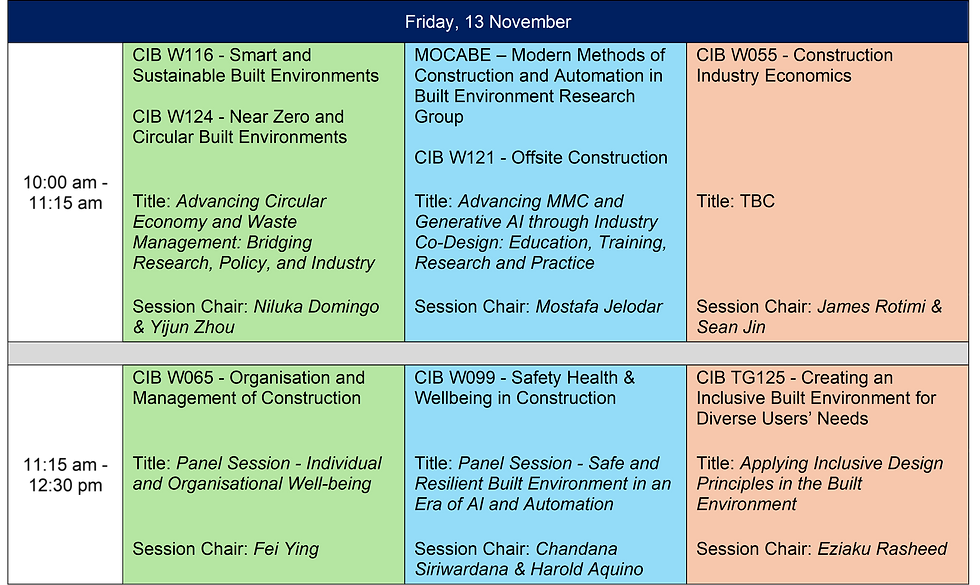

A guided tour of Te Matapihi ki te Ao Nui (Wellington Central Library) with Athfield Architects, the original architects of the building.
This site visit will take place on Friday, 13 November 2026, from 2:00–4:00 pm.
Industry
Academia
Student
$350 (incl GST)
$350 (incl GST)
$250 (incl GST)The symposium registration fee includes attendance at all sessions during the symposium, lunch and conference dinner (evening of Day 2, 13 November 2026). At least one of the authors of an accepted paper must be registered for the paper to be included in the conference proceeding. Each registration can cover up to two papers.
GOLD
SPONSOR
NZ$5000.00
Sponsorship includes:
-
4 X Complimentary registrations for the symposium & dinner
-
Your logo in the symposium proceeding
-
Desk in exhibition space
-
10-minute presentation at plenary session
-
Naming rights as sponsor for dinner (13 November 2026)
SILVER
SPONSOR
NZ$2500.00
Sponsorship includes:
-
2 X Complimentary registrations for the symposium & dinner
-
Your logo in the symposium proceeding
-
Desk in exhibition space
-
Naming rights for either one of the following:
-
one of the symposium sessions; or
-
Lunch event on 13 November 2026
-
BRONZE
SPONSOR
NZ$1000.00
Sponsorship includes:
-
1 X Complimentary registration for the symposium & dinner
-
Your logo in the symposium proceeding
-
Desk in exhibition space
-
Mantra Central Wellington has agreed to offer a preferred accommodation discount of 15% off the Best Available Rate of the day for the conference delegates attending the New Zealand Built Environment Research Symposium 2026.
Discount applies to stays from 11th to 15th November (inclusive) only.
Address: 130 Victoria Street, Te Aro, Wellington. See on Google Map
Book through here.
Collaborators (Institutitions)


Event Endorsed By:


NZBERS2026
"People and the Built Environment"
Symposium themes:
-
Health, Safety and Wellbeing
-
Skills, Education and Workforce Development
-
Leadership and Empowerment
-
People, Policy and Industry Support
-
Innovation, Research and Collaboration
-
Design, Culture and Community Impact
12 - 13 November 2026
Massey University, Wellington, New Zealand
NZBERS 2026 provides a practical platform for construction and built environment professionals to share knowledge, showcase innovation, and connect research with real-world industry challenges. Industry participants will gain early access to emerging research, tools, and case studies, while exploring opportunities for applied research collaboration, student internships, and professional development with the School of Built Environment. We welcome theoretical, empirical, practice-based, and policy-focused contributions, and strongly encourage submissions from early-career researchers, postgraduate students, and industry practitioners. This symposium offers valuable opportunities to engage with government and key sector organisations, including BRANZ and the Ministry of Business, Innovation and Employment (MBIE).
Abstract Submission Closing
30 April 2026
Abstract Acceptance
15 May 2026
Full Paper and Extended Abstract Submission Closing
30 June 2026
Full Paper and Extended Abstract Acceptance
07 September 2026
Revised Paper Submission Closing
30 September 2026
Camera Ready Submission Closing
15 October 2026
NZBERS2026 Symposium
12 - 13 November 2026
Chairs
Dr. Don Samarasinghe
Massey University
Assoc. Prof. Michael Rehm
University of Auckalnd
AdvisorsDr. Wajiha Shahzad
Massey University
Prof. Monty Sutrisna
Massey University
Prof. James Rotimi
Massey University
Dr. Eziaku Rasheed
Massey University
Organising Committee
Dr. Mikael Boulic
Massey University
Dr. Chandana Siriwardana
Massey University
Dr. An Le
Massey University
Dr. Zhenan Feng
Massey University
Dr. Harold Aquino
Massey University
Dr. Chinthaka Atapattu
Massey University
Dr. Fahimeh McGregor-Zaeri
Delta Informed Decisions
Dr. Imelda Piri
Auckland University of Technology
Mr. Wajhat Ali
Otago Polytechnic Auckland Campus
Dr. Fei Ying
Massey University
Dr. Elrasheid Elkhidir
Massey University
Dr. Vishal Kumar
Massey University
Dr. Wallace Enegbuma
Victoria University of Wellington
Abstract and Extended Abstract Submission Link
Please login to Microsoft CMT using the link below for submission. First you need to register a Microsoft CMT account. Then click on “Create new submission” on the top left of the page to proceed with the submission.
Full Paper Submission Link
Please login to Microsoft CMT using the link below for submission. If you have submitted an abstract before, replace the abstract document with the full paper document.
Abstract Template
Extended Abstract Template
Full Paper Template
Presentation Template
Note*
All accepted papers for NZBERS2026, in accordance with our agreement with Springer Nature, will be published in the proceedings and Scopus Indexed.
All extended abstracts will be published in the Book of Abstracts (not Scopus-indexed).
Senior Healthy Water Specialist, Auckland Council
Civil Engineer and Governance Practitioner
People at the Centre: Why Capability Will Shape Aotearoa’s Infrastructure Future
Aotearoa is heading into a period of overlapping infrastructure reform, water sector change, climate pressures, and rising expectations from communities. We often talk about these shifts in terms of assets, funding, or structure. But the factor that is already shaping outcomes the most is capability, who we have, who we’re losing, and who we’re not developing fast enough.
This keynote looks at the emerging workforce gap across engineering, operations, asset management, planning, and regulatory roles. The loss of experienced practitioners and the thinning of the mid career cohort are creating real constraints on delivery and resilience.
Drawing on research into infrastructure resilience and organisational recovery, I argue that resilience is increasingly determined by people and systems, not just assets. Organisations with strong leadership and mature capability recover faster and deliver more consistent results.
To make this concrete, I outline three possible futures for Aotearoa: one where capability continues to erode, one where we rely heavily on overseas expertise, and one where we treat workforce development as national infrastructure.
The abstract closes with a call to stewardship, a shared responsibility across the sector to build the capability base needed for a resilient, future focused Aotearoa.
Chief Executive, Asian Family Services (AFS)
Ethnic Advisory Board Member NZ PoliceThe Tip of the iceberg- A Cultural Lens on Wellbeing and Suicide Prevention in Construction
Construction is one of Aotearoa’s largest workforces and one of its highest-risk industries for suicide. MATES in Construction reports that male construction workers face nearly twice the suicide rate of other men, 19.7 compared with 10.6 per 100,000, with more than one construction worker dying by suicide every week. The New Zealand Chinese Building Industry Association’s 2025 State of the Sector report shows the sector’s scale: $94 billion in value, 294,000 direct workers, and a workforce that is still 84% male. The last Asian Construction Sector Report also showed 44,928 Asian-descended construction professionals, a 160% increase in five years, and reported significant Asian-led activity across the upper North Island.
From an Asian lens, suicide risk can be deeply hidden behind silence, shame, migration stress, language barriers, family responsibility, visa and financial pressure, racism, and workplace hierarchy. AFS research found 57.2% of Asian respondents are at risk of depression, showing the wider mental health burden carried into workplaces.
Using the AFS Integrated Tree Model, this keynote looks beneath the surface: roots of culture, identity and migration; branches of workplace stress; and fruits of wellbeing or harm. The solution must be culturally safe, community-led, and workplace-based. By empowering community leaders, strengthening cultural capability across construction workplaces, and applying the AFS Integrated Tree Model, we can create safer environments where distress is recognised earlier, culturally appropriate support is offered at the right time, and people feel seen before they reach crisis. In suicide prevention, one life lost is one too many.Associate Pro Vice-Chancellor - Enterprise and Business Innovation
School of Arts, Design and Architecture
De Montfort University
Evaluating Impact Through Innovation in Flood Risk Management: Lessons from the UK Flood and Coastal Resilience Innovation.
In recent years, there has been a shift in flood risk management from a primary focus on protection towards a broader emphasis on resilience, adaptation and innovation. In the UK, the Flood and Coastal Resilience Innovation Programme (FCRIP) has provided a unique opportunity to trial and evaluate innovative approaches to managing flood and coastal risks across a diverse range of communities.
This keynote draws on emerging insights from one of the projects supported through the FCRIP programme, the FAIR Project, to explore how innovation can be effectively translated into measurable impact. It examines a range of interventions, including property flood resilience (PFR), nature-based solutions, community engagement approaches, and data-driven decision tools. Particular attention is given to how these initiatives perform in practice, including the challenges of implementation, the role of local context, and the importance of stakeholder collaboration.
A central theme of the presentation is the need for robust evaluation frameworks that capture not only technical performance, but also social, economic and behavioural outcomes. The keynote highlights lessons learned in assessing impact, including the importance of longitudinal data, user experience, and the alignment between expectations and real-world outcomes.
The presentation concludes by reflecting on how these lessons can inform future policy, practice and research, both in the UK and internationally, to support more effective, inclusive and adaptive flood resilience strategies.Executive General Manager
Hawkins
Leadership and Empowerment in Construction
The presentation provides a leadership perspective from an experienced Construction leader who has progressed through multiple roles within the business. It outlines the scale and performance of Hawkins today, highlighting some of the significant projects we deliver right across NZ with an excellent team. Central to the presentation is the importance of leadership in driving successful outcomes in a demanding construction environment.
Leadership is framed through three key dimensions: visible, courageous, and authentic leadership. Visible leadership emphasises presence, engagement, and accountability, encouraging leaders to build meaningful relationships, communicate transparently, and consistently follow through on commitments. Courageous leadership focuses on maintaining a positive attitude, demonstrating resilience, managing pressure calmly, and engaging in difficult but necessary conversations to achieve results. Authentic leadership highlights the importance of being genuine, self-aware, and adaptable, fostering trust and strong personal connections within teams.
A key theme is accountability —by setting clear expectations and providing ongoing support, leaders enable individuals to take ownership, make decisions, and contribute to become high-performing teams.
The presentation reinforces that effective leadership directly contributes to high-performing teams and organisational success. It also recognises the importance of wellbeing and balance, acknowledging the pressures of the industry while encouraging leaders to support both their own and their teams’ performance and health. Ultimately, the message is clear: strong, values-driven leadership is critical to sustaining a successful business in a challenging industry.
The Friday morning programme of NZBERS 2026 (13 November) is dedicated to CIB Working Commissions and Task Groups, bringing together the international CIB community and NZBERS delegates for focused discussions across key areas of built environment research.
The parallel sessions will provide opportunities for knowledge exchange, networking and international research collaboration, with contributions from a range of CIB Working Commissions and Task Groups.A guided tour of Te Matapihi ki te Ao Nui (Wellington Central Library) with Athfield Architects, the original architects of the building.
This site visit will take place on Friday, 13 November 2026, from 2:00–4:00 pm.
Industry
Academia
Student
$350 (incl GST)
$350 (incl GST)
$250 (incl GST)The symposium registration fee includes attendance at all sessions during the symposium, lunch and conference dinner (evening of Day 2, 13 November 2026). At least one of the authors of an accepted paper must be registered for the paper to be included in the conference proceeding. Each registration can cover up to two papers.
GOLD
SPONSOR
NZ$5,000
Sponsorship includes:
-
4 X Complimentary registrations for the symposium & dinner
-
Your logo in the symposium proceeding
-
Desk in exhibition space
-
10-minute presentation at plenary session
-
Naming rights as sponsor for dinner (13 November 2026)
SILVER
SPONSOR
NZ$2,500
Sponsorship includes:
-
2 X Complimentary registrations for the symposium & dinner
-
Your logo in the symposium proceeding
-
Desk in exhibition space
-
Naming rights for either one of the following:
-
one of the symposium sessions; or
-
Lunch event on 13 November 2026
-
BRONZE
SPONSOR
NZ$1,000
Sponsorship includes:
-
1 X Complimentary registration for the symposium & dinner
-
Your logo in the symposium proceeding
-
Desk in exhibition space
-
Mantra Central Wellington has agreed to offer a preferred accommodation discount of 15% off the Best Available Rate of the day for the conference delegates attending the New Zealand Built Environment Research Symposium 2026.
Discount applies to stays from 11th to 15th November (inclusive) only.
Book through here.
Address: 130 Victoria Street, Te Aro, Wellington. See on Google MapCollaborators (Institutitions)
Event Endorsed By:
Mantra Central Wellington has agreed to offer a preferred accommodation discount of 15% off the Best Available Rate of the day for the conference delegates attending the New Zealand Built Environment Research Symposium 2026.
Discount applies to stays from 12th to 15th November (inclusive) only.
Book through here.
Abstract Submission Closing
30 April 2026
Abstract Acceptance
15 May 2026
Full Paper and Extended Abstract Submission Closing
15 June 2026
Full Paper and Extended Abstract Acceptance
01 August 2026
Revised Paper Submission Closing
01 September 2026
Camera Ready Submission Closing
30 September 2026
NZBERS2026 Symposium
12 - 13 November 2026
Chairs
Dr. Don Samarasinghe
Massey University
Assoc. Prof. Michael Rehm
University of Auckalnd
AdvisorsDr. Wajiha Shahzad
Massey University
Prof. Monty Sutrisna
Massey University
Prof. James Rotimi
Massey University
Dr. Eziaku Rasheed
Massey University
Organising Committee
Dr. Mikael Boulic
Massey University
Dr. Chandana Siriwardana
Massey University
Dr. An Le
Massey University
Dr. Zhenan Feng
Massey University
Dr. Harold Aquino
Massey University
Dr. Chinthaka Atapattu
Massey University
Dr. Fahimeh McGregor-Zaeri
Delta Informed Decisions
Dr. Imelda Piri
Auckland University of Technology
Mr. Wajhat Ali
Otago Polytechnic Auckland Campus
Dr. Fei Ying
Massey University
Dr. Elrasheid Elkhidir
Massey University
Dr. Vishal Kumar
Massey University
Dr. Wallace Enegbuma
Victoria University of Wellington
Abstract and Extended Abstract Submission Link
Please login to Microsoft CMT using the link below for submission. First you need to register a Microsoft CMT account. Then click on “Create new submission” on the top left of the page to proceed with the submission.
Full Paper Submission Link
To be confirmed
Abstract Template
Extended Abstract Template
Full Paper Template
Presentation Template
Note*
All accepted papers for NZBERS2026, in accordance with our agreement with Springer Nature, will be published in the proceedings and Scopus Indexed.
All extended abstracts will be published in the Book of Abstracts (not Scopus-indexed).
Senior Healthy Water Specialist, Auckland Council
Civil Engineer and Governance Practitioner
People at the Centre: Why Capability Will Shape Aotearoa’s Infrastructure Future
Aotearoa is heading into a period of overlapping infrastructure reform, water sector change, climate pressures, and rising expectations from communities. We often talk about these shifts in terms of assets, funding, or structure. But the factor that is already shaping outcomes the most is capability, who we have, who we’re losing, and who we’re not developing fast enough.
This keynote looks at the emerging workforce gap across engineering, operations, asset management, planning, and regulatory roles. The loss of experienced practitioners and the thinning of the mid career cohort are creating real constraints on delivery and resilience.
Drawing on research into infrastructure resilience and organisational recovery, I argue that resilience is increasingly determined by people and systems, not just assets. Organisations with strong leadership and mature capability recover faster and deliver more consistent results.
To make this concrete, I outline three possible futures for Aotearoa: one where capability continues to erode, one where we rely heavily on overseas expertise, and one where we treat workforce development as national infrastructure.
The abstract closes with a call to stewardship, a shared responsibility across the sector to build the capability base needed for a resilient, future focused Aotearoa.
Chief Executive, Asian Family Services (AFS)
Ethnic Advisory Board Member NZ PoliceThe Tip of the iceberg- A Cultural Lens on Wellbeing and Suicide Prevention in Construction
Construction is one of Aotearoa’s largest workforces and one of its highest-risk industries for suicide. MATES in Construction reports that male construction workers face nearly twice the suicide rate of other men, 19.7 compared with 10.6 per 100,000, with more than one construction worker dying by suicide every week. The New Zealand Chinese Building Industry Association’s 2025 State of the Sector report shows the sector’s scale: $94 billion in value, 294,000 direct workers, and a workforce that is still 84% male. The last Asian Construction Sector Report also showed 44,928 Asian-descended construction professionals, a 160% increase in five years, and reported significant Asian-led activity across the upper North Island.
From an Asian lens, suicide risk can be deeply hidden behind silence, shame, migration stress, language barriers, family responsibility, visa and financial pressure, racism, and workplace hierarchy. AFS research found 57.2% of Asian respondents are at risk of depression, showing the wider mental health burden carried into workplaces.
Using the AFS Integrated Tree Model, this keynote looks beneath the surface: roots of culture, identity and migration; branches of workplace stress; and fruits of wellbeing or harm. The solution must be culturally safe, community-led, and workplace-based. By empowering community leaders, strengthening cultural capability across construction workplaces, and applying the AFS Integrated Tree Model, we can create safer environments where distress is recognised earlier, culturally appropriate support is offered at the right time, and people feel seen before they reach crisis. In suicide prevention, one life lost is one too many.Associate Pro Vice-Chancellor - Enterprise and Business Innovation
School of Arts, Design and Architecture
De Montfort University
Evaluating Impact Through Innovation in Flood Risk Management: Lessons from the UK Flood and Coastal Resilience Innovation.
In recent years, there has been a shift in flood risk management from a primary focus on protection towards a broader emphasis on resilience, adaptation and innovation. In the UK, the Flood and Coastal Resilience Innovation Programme (FCRIP) has provided a unique opportunity to trial and evaluate innovative approaches to managing flood and coastal risks across a diverse range of communities.
This keynote draws on emerging insights from one of the projects supported through the FCRIP programme, the FAIR Project, to explore how innovation can be effectively translated into measurable impact. It examines a range of interventions, including property flood resilience (PFR), nature-based solutions, community engagement approaches, and data-driven decision tools. Particular attention is given to how these initiatives perform in practice, including the challenges of implementation, the role of local context, and the importance of stakeholder collaboration.
A central theme of the presentation is the need for robust evaluation frameworks that capture not only technical performance, but also social, economic and behavioural outcomes. The keynote highlights lessons learned in assessing impact, including the importance of longitudinal data, user experience, and the alignment between expectations and real-world outcomes.
The presentation concludes by reflecting on how these lessons can inform future policy, practice and research, both in the UK and internationally, to support more effective, inclusive and adaptive flood resilience strategies.
Industry
Academia
Student
$350 (incl GST)
$350 (incl GST)
$250 (incl GST)The symposium registration fee includes attendance at all sessions during the symposium, lunch and conference dinner (evening of Day 2, 13 November 2026). At least one of the authors of an accepted paper must be registered for the paper to be included in the conference proceeding. Each registration can cover up to two papers.
GOLD
SPONSOR
NZ$5,000
Sponsorship includes:
-
4 X Complimentary registrations for the symposium & dinner
-
Your logo in the symposium proceeding
-
Desk in exhibition space
-
10-minute presentation at plenary session
-
Naming rights as sponsor for dinner (13 November 2026)
SILVER
SPONSOR
NZ$2,500
Sponsorship includes:
-
2 X Complimentary registrations for the symposium & dinner
-
Your logo in the symposium proceeding
-
Desk in exhibition space
-
Naming rights for either one of the following:
-
one of the symposium sessions; or
-
Lunch event on 13 November 2026
-
BRONZE
SPONSOR
NZ$1,000
Sponsorship includes:
-
1 X Complimentary registration for the symposium & dinner
-
Your logo in the symposium proceeding
-
Desk in exhibition space
-
Accommodation Options
Collaborators (Institutitions)
Event Endorsed By:
The Microsoft CMT service was used for managing the peer-reviewing process for this conference. This service was provided for free by Microsoft and they bore all expenses, including costs for Azure cloud services as well as for software development and support.